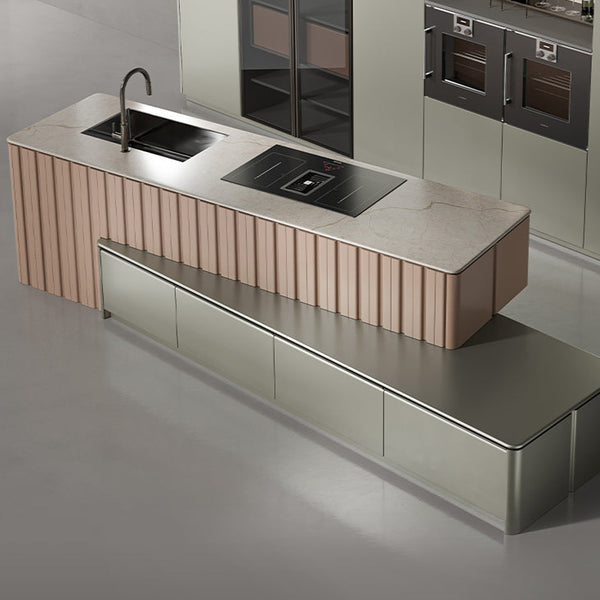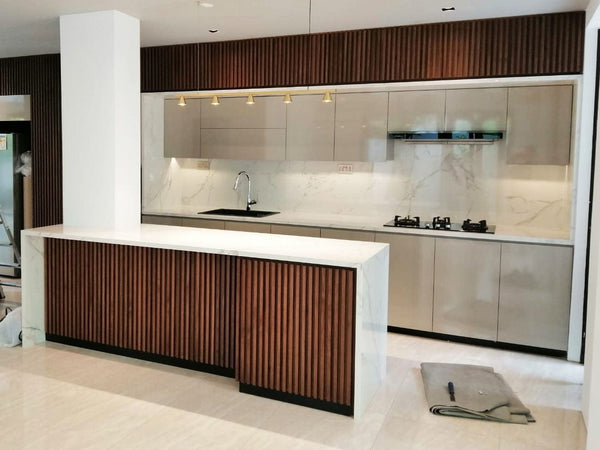


Is it safe to buy imported carpentry?
It has become very trendy in Singapore and the question is on everybody's lips: is it safe to buy imported carpentry? Well, it's generally safe, but the quality varies significantly depending on the manufacturer, materials, and local installation team.
For homeowners in Singapore, the main considerations are usually not whether the carpentry is imported, but rather:
1. Formaldehyde Emissions
This is often the biggest health concern.
Look for boards that meet recognized standards such as:
- E0 (very low emissions)
- ENF (No Added Formaldehyde, a newer Chinese standard)
- CARB Phase 2 (North America)
- F★★★★ (Japan)
Low-formaldehyde boards can help reduce indoor air pollution, which is especially important in Singapore where homes are air-conditioned and relatively sealed.
Read more about Oppolia's Craftsmanship
2. Moisture Resistance
Singapore’s humidity can be hard on cabinetry.
Good imported carpentry should use:
- Moisture-resistant plywood
- Moisture-resistant particle board or MDF
- Quality edge banding to prevent water ingress
For kitchens and bathrooms, moisture resistance is often more important than whether the cabinets are made locally or overseas.
3. Hardware Quality
Many premium imported cabinet systems use hardware from companies such as Blum, Hettich, and Häfele.
Quality hinges and drawer runners often determine how well cabinets perform after 5–10 years.
Read more about our 5-Year Warranty Policy
4. Manufacturing Consistency
Factory-produced imported carpentry can actually be more consistent than some site-built carpentry because:
- Computer-controlled cutting improves accuracy.
- Factory finishing is usually more uniform.
- Better quality control processes are possible.
This is one reason imported modular cabinetry has become increasingly popular in Singapore.
5. Installation Quality in Singapore
Even excellent imported cabinets can perform poorly if installed badly.
Check:
- Who is responsible for installation?
- Whether measurements are verified before production.
- What warranty is provided for adjustment and rectification.
Many issues homeowners attribute to “poor imported carpentry” are actually installation problems.

Read more about HomeShake's Singapore Carpenters
Advantages of Imported Carpentry
- Better manufacturing precision.
- Often lower cost for comparable quality.
- Wider range of finishes and accessories.
- Faster production for standardized systems.
Potential Drawbacks
- Longer lead times if replacement parts are needed.
- Less flexibility for unusual spaces.
- Warranty claims can be more complicated if the supplier has no local support.
- Quality varies greatly between factories.
For Singapore BTOs and Condos
Imported carpentry is generally safe if the supplier can provide:
- Formaldehyde emission certification.
- Board specifications.
- Hardware specifications.
- Local warranty and after-sales service.
A well-made imported cabinet using E0/ENF boards and quality hardware can easily outperform poorly made local carpentry. The key is to evaluate the materials, certifications, and installer—not simply whether the cabinets are imported or locally produced. Have a look at OPPOLIA's quality and you will be convinced.
Find more info here:
Everything you need to know about Oppolia by HomeShake
HomeShake's Wardrobe with Formaldehyde-Free Panels
FAQs
How long does it take to manufacture imported cabinets?
Oppolia's lead time is 4 weeks to manufacture and 2 weeks to ship. This means that, from the moment the order is fully confirmed and locked in, all the cabinets will be installed within 2 months only.
What if there is a defect?
In case of defect and for any aftersales order, we use a fast-track process to manufacture within 2 weeks. This means that from the moment the claim is accepted, the item will be replaced within 1 month.
Can I use my own local carpenter to install?
In order to benefit from our 5-year warranty, all cabinets must be installed by our approved carpenters. As of today, only HomeShake's carpenters can offer the level of quality required for a beautiful installation of our cabinets.